
Talking Rock, GA Wedding Photos — What Happens When You Build Your Day Around the Light
Most wedding day timelines are built around the ceremony, the reception, and what the caterer needs. The best wedding day timelines — the ones that produce the photographs couples hang on their walls for thirty years — are built around the light. In Talking Rock, Georgia, the light gives you something extraordinary to build around.
Talking Rock sits in Pickens County, nestled in a creek valley between Jasper to the south and Ellijay to the north, where the Blue Ridge Mountains begin to assert themselves in a serious way. It’s a community rather than a city — small enough that it has a post office and a general store and not much else in the way of commercial infrastructure — and that smallness is exactly what makes it right for a certain kind of wedding. The forested ridges on either side of Talking Creek valley create a natural enclosure that photographers love: the ridgelines give you a background element that’s present and interesting without dominating, the creek bottom provides a different, more intimate environment for close portraits, and the clearings on the valley floor catch the afternoon light in a way that feels specifically designed for wedding photographs, even though it was designed by nothing except topography and time. I’ve worked in the Talking Rock area multiple times, and what strikes me every time is how the place rewards slowing down. The more deliberately you move through the day — the more you allow the light and the landscape to inform your timing rather than rushing through locations — the better the photographs become. Talking Rock is not a place that performs well under pressure. It is a place that opens up when you give it time.

Understanding Mountain Light in a Valley Setting
Mountain light in a valley setting is a different animal from the open-sky light that farms and coastal properties work with. In Talking Rock, the creek valley runs roughly north to south, which means that east and west ridgelines shadow the valley at different times of day. The east ridge cuts off morning light earlier than you’d expect at this latitude — sunrise here happens later in the valley than it does on the exposed ridge above — and the west ridge accelerates the onset of shadow in the afternoon. The window of direct sun in the valley floor is compressed compared to an open field at the same latitude. But here’s what that compression creates: a more dramatic quality of light when the sun is present. When the afternoon sun clears the east ridge and drops into the valley, it’s already at an angle. It’s already warm and low. The kind of light that open-field photographers have to wait until two hours before sunset to achieve arrives in the Talking Rock valley in the mid-afternoon, simply because of the terrain. For a photographer who knows this — who plans the portrait session to coincide with the valley’s specific window — it means the absolute best light of the day can happen at 3:30 in the afternoon rather than 6:30. That is a meaningful logistical gift on a wedding day when sunset portraits often conflict with reception dinner timing.
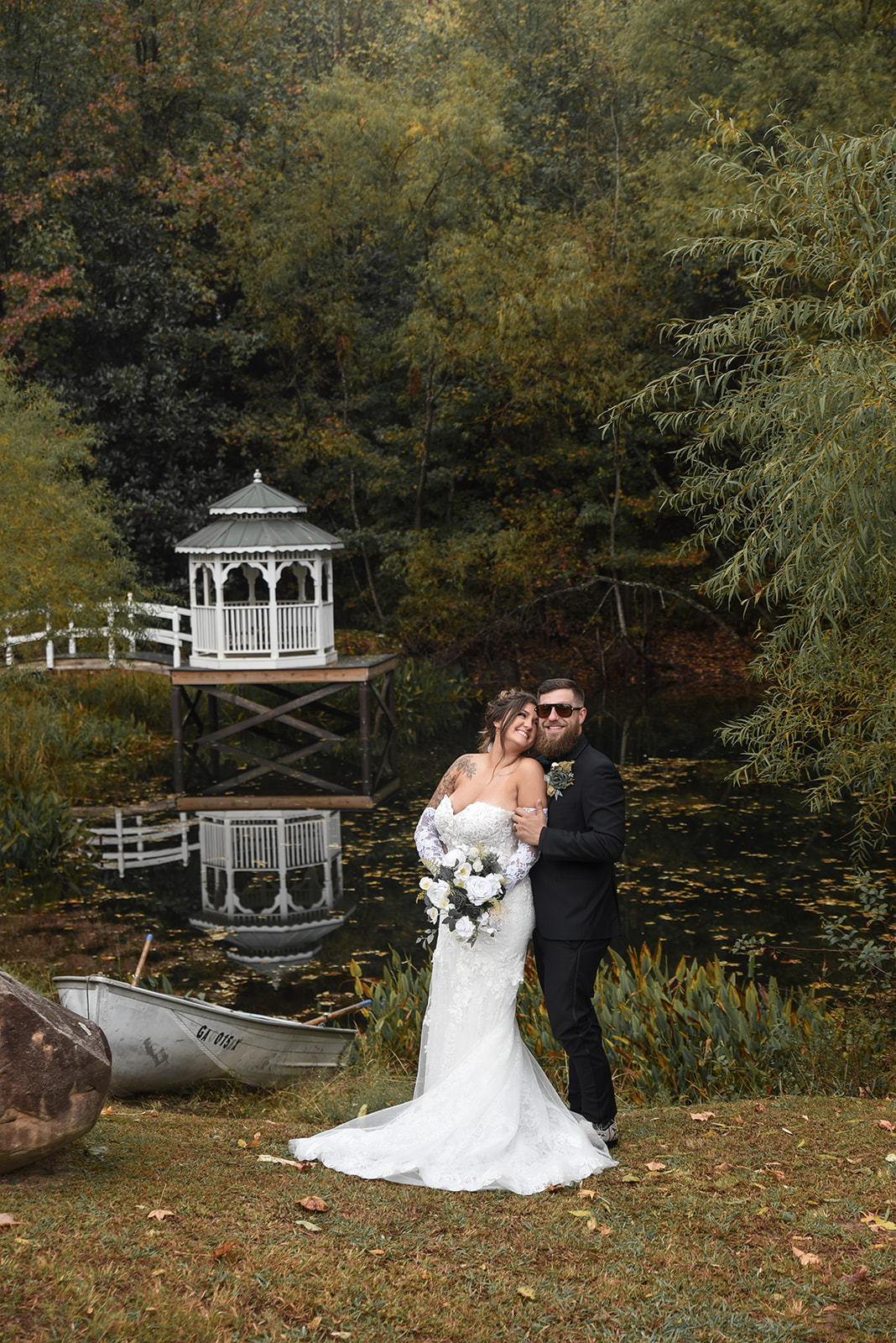
The creek itself is a secondary environment that I use extensively in Talking Rock. Talking Creek runs clear over smooth river stones, and the canopy over the creek bottom — sycamores and tulip poplars and river birch, mostly — creates a cathedral-like shade that holds detail beautifully even at midday when the valley floor light would otherwise be too harsh for portraits. The sound of the water is present in every moment of a creek-side portrait session in a way that relaxes people; I’ve noticed this across many locations and many couples, and the Talking Rock creek is particularly effective because the water moves quickly enough to be audible without being loud. It creates a kind of acoustic privacy, a sense of being enclosed and apart, that translates into portraits where the couple is genuinely present with each other rather than performing. I have never had a couple who felt stiff beside a moving creek. The water does something to people — takes the performance out of them and replaces it with presence — and presence is everything in a wedding portrait.
Small Weddings and the Off-Grid Feeling
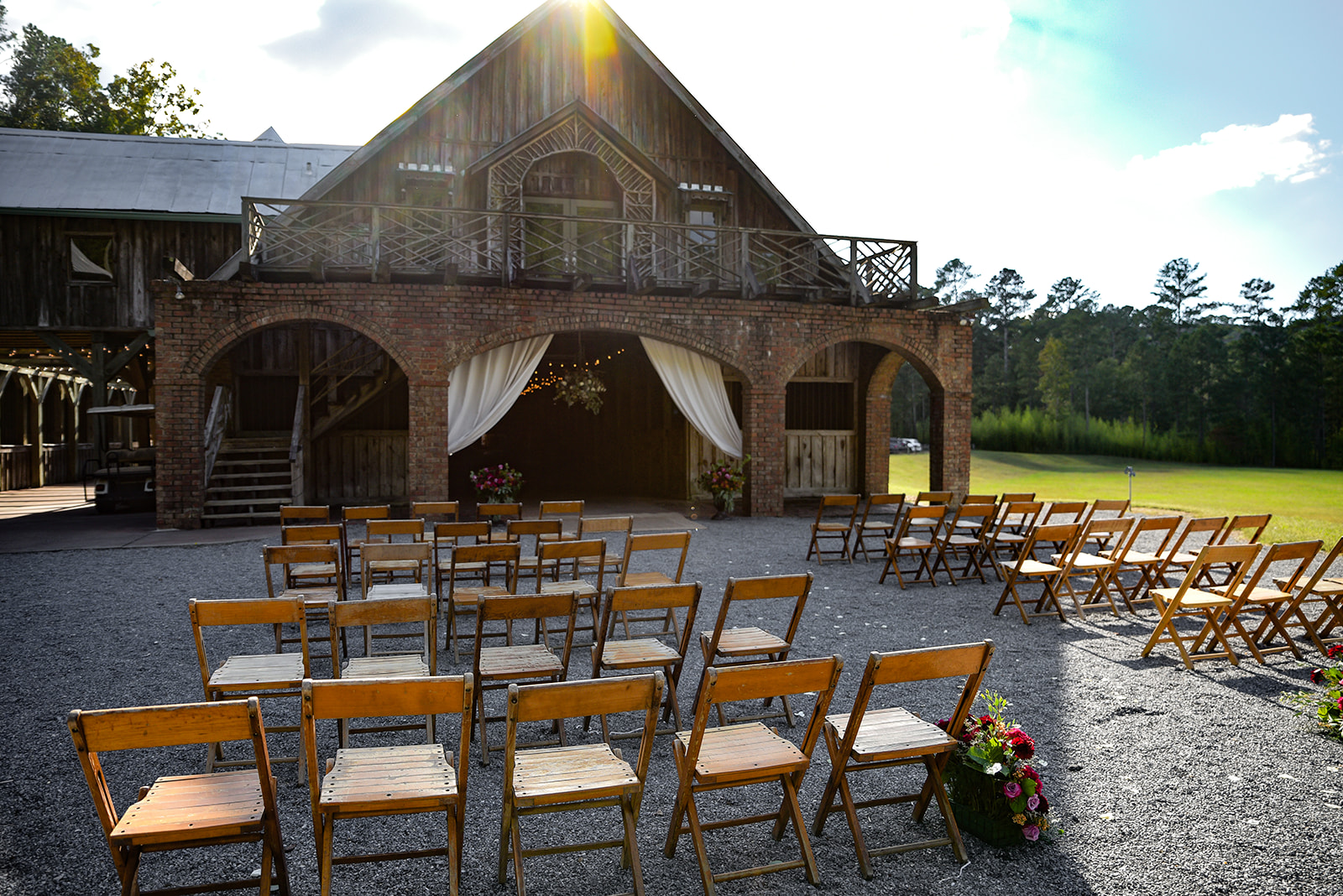
Talking Rock tends to attract couples who want their wedding to feel genuinely away from things. Not isolated — not inaccessible — but away from the specific kind of noise that attends large, highly produced wedding events. The couples I photograph here are typically choosing smaller guest lists, intimate ceremonies with their closest people, receptions that feel more like gatherings than productions. The landscape supports this. There are no conference-center ballrooms in Talking Rock, no purpose-built event spaces with industrial catering kitchens and standardized lighting packages. What exists here are private properties — creek-side clearings, mountain-facing meadows, barns that belong to families who have kept them maintained for reasons having nothing to do with wedding hosting — and the experience of getting married in these spaces is categorically different from the experience of booking a venue. The couple arriving at a Talking Rock wedding comes to a specific place that belongs to specific people, and the intimacy of that context shapes every moment of the day. When 60 people gather in a meadow above Talking Creek to watch two people make a commitment, the scale of the event and the scale of the landscape are in proportion to each other in a way that large venues rarely achieve. The mountains are big. The wedding is appropriately small. The photographs reflect both truths simultaneously.
I want to be honest about what “building your day around the light” actually means in practice, because I think it’s sometimes described in mystical terms that obscure a fairly concrete set of decisions. It means, first, knowing what the light at your specific location does at different times of day — which requires either personal experience with the site or a meaningful conversation with your photographer before the day. It means, second, structuring your ceremony and reception timing around those light windows rather than accepting the default framework of ceremony-at-4pm, dinner-at-7pm. It often means scheduling the ceremony earlier than conventional wisdom suggests — sometimes noon or early afternoon — so that the portrait session can happen during the valley’s best light, in the two-to-four-hour window before the reception begins. It means being willing to have dinner at 5:30 rather than 7:00. These are not dramatic sacrifices. Most couples, when they see what the right light produces in their photographs, consider them obvious choices that they wish they’d been told about earlier. I tell couples about them at the first conversation, because getting the light right is not a detail — it’s the foundation on which every image in the gallery is built.
“The creek does something to people — takes the performance out of them and replaces it with presence — and presence is everything in a wedding portrait.”
What I love most about Talking Rock is the way it enforces the right priorities by its own nature. You cannot be distracted by the trappings of a large production wedding when you’re in a meadow above a mountain creek with fifty of your closest friends. The simplicity that the landscape imposes is the same simplicity that makes the photographs extraordinary. When there’s nothing to look at but the people and the mountains and the light, the photographs are about those things — and those things, documented well, are more than enough. I’ve made some of my favorite images in places that had no infrastructure at all, no designed backdrop, no anything except the right people in the right light in the right landscape. Talking Rock, at its best, is exactly that kind of place.
Practical Planning for a Talking Rock Wedding
The logistics of a Talking Rock wedding are different from those of a venue-based event, and they benefit from early planning. The primary question is venue access — private properties in the Talking Rock area are typically accessed through personal connections or through word-of-mouth referrals that require some local knowledge to navigate. A photographer who has worked in Pickens County extensively can be a useful resource here, because the relationship between the creative team and the property owners matters. For couples who want the mountain creek environment but need some infrastructure — restrooms, parking, power access — there are properties in the broader Jasper and Ellijay area that bridge the gap between fully rustic and fully produced. I’ve worked at a range of these and can point couples toward the options that match their specific balance of visual and logistical priorities. The drive from Atlanta to Talking Rock is about 75 minutes, which makes it genuinely accessible for metro guests. From Chattanooga, it’s about an hour. Highway 515 runs through Jasper just south of Talking Rock, providing a clear and relatively quick corridor from I-575.
For couples who have been searching for a North Georgia mountain wedding that feels genuinely apart from the increasingly saturated Blue Ridge venue market — where the same venues appear in the same galleries and the images are harder and harder to distinguish from each other — Talking Rock is worth a serious look. It requires more research to bring together than a standard venue booking, and the logistics need more active management. But the photographs that come out of a Talking Rock wedding, built around the specific quality of light in that creek valley, are photographs that belong to that place and no other. That particularity is, ultimately, what you’re paying for when you hire a wedding photographer. Talking Rock makes it easier to get there than almost anywhere else I work in North Georgia.
Build your day around the light. Show up to Talking Rock with enough time to let the valley do its work. Bring fifty people who love you and mean it. The photographs will be exactly what you hoped they could be, and then a little more than that — because the mountains here have a way of adding something that no amount of planning can fully anticipate.
Tiffany Greeson Photography serves couples, families, and newborns throughout Northwest Georgia and the greater Southeast, including Talking Rock and surrounding communities of Calhoun, Rome, Cartersville, Dalton, Canton, Chattanooga (TN), Blue Ridge, Dahlonega, and beyond. Available for destination weddings throughout the Southeast and nationwide.
Ready to have your wedding photographed?
Send your date, venue, and a little about your day. I’ll come back with availability and next steps — usually within 24–48 hours.
Begin Your Inquiry